Benefits of Puzzles for Adults: Calm, Focus and Fun
What are the real benefits of puzzles for adults? Calm, focus and a mood boost. See what studies say and how to pick jigsaw, word or puzzle games.
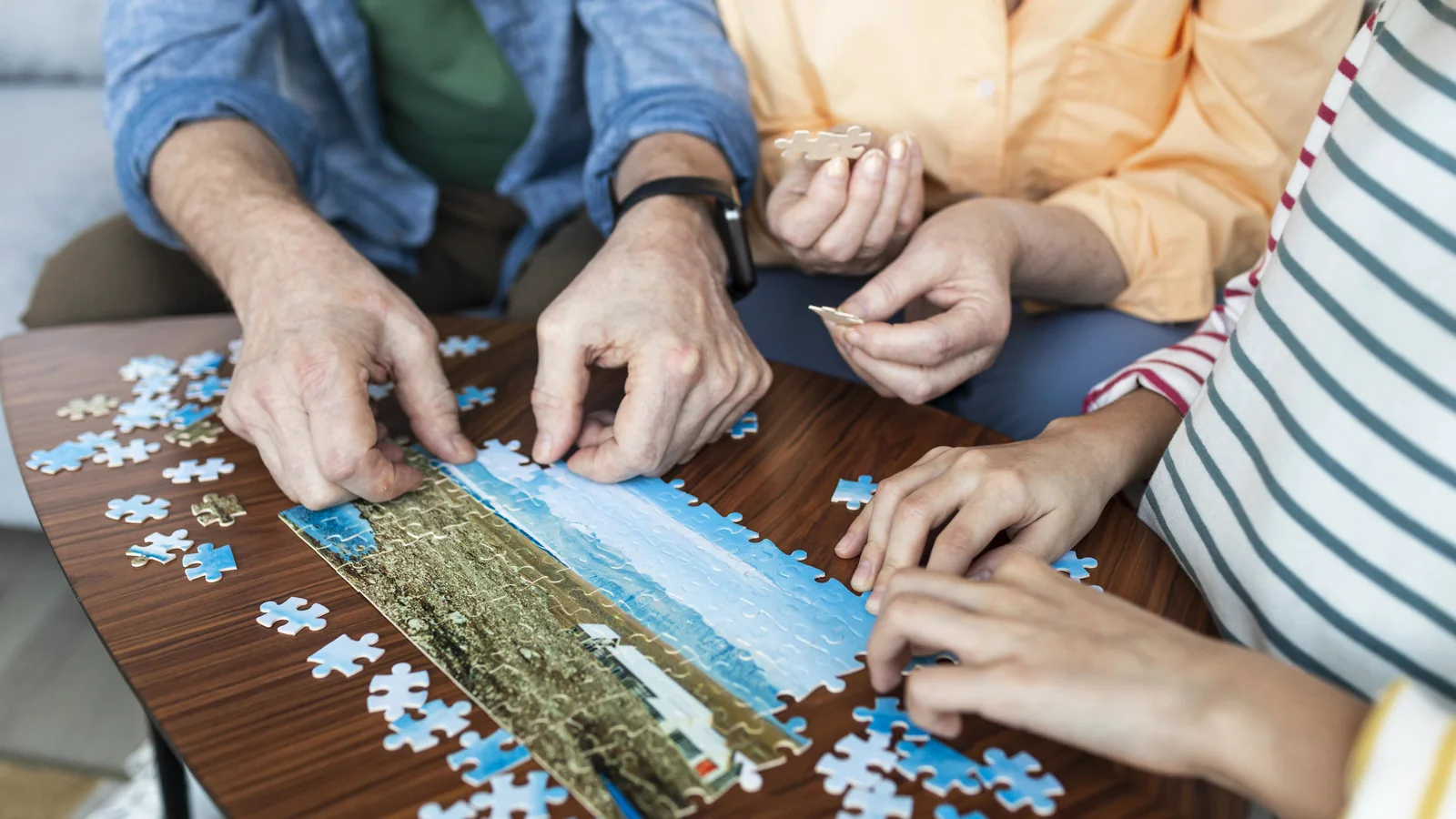
Maybe it's the 1,000-piece puzzle that took over the dining table in January. Maybe it's the crossword with your morning coffee, or a puzzle game on the bus home. Either way, you've probably felt it: twenty minutes go by, and your head is quieter. So what are the real benefits of puzzles for adults, and which ones does science actually back? Here's what the studies found, how strong that evidence is, and how to pick the right kind of puzzle for you.
Key takeaways
- The most reliable benefit is the simplest: a puzzle gives a busy mind one calm, absorbing thing to do, plus a small win.
- Jigsaw skill is linked to eight thinking abilities, from working memory to reasoning, in adults aged 50 and over.
- People who often do crosswords or Sudoku score better on attention, reasoning and memory tests, but that is a link, not proof.
- A month of daily jigsaws made people better at jigsaws, not at other thinking tests.
- For relaxation, pick puzzles with no timer and short sessions, and stop while it still feels good.
What does research say about the benefits of puzzles?
Three bodies of research come up again and again.
Jigsaw puzzles use a lot of your brain at once. In a German study led by Patrick Fissler, 100 healthy adults aged 50 and over were tested on jigsaw skill and on eight thinking abilities. Jigsaw skill was linked to all eight: visual perception, mental rotation, processing speed, flexible thinking, working memory, reasoning, episodic memory and the ability to put parts together into a whole. People who had done more jigsaws over their lifetime also had better visuospatial skills.
Word and number puzzles go with sharper thinking later in life. The PROTECT study, run by the University of Exeter and King's College London, looked at more than 19,000 adults aged 50 and over. The more often people did crosswords and number puzzles like Sudoku, the better they did on tests of attention, reasoning and memory. Even so, the lead researcher was careful to say the study can't show that puzzles lower the risk of dementia.
Mentally active hobbies are linked to lower dementia risk in older adults. An Australian study of 10,318 people aged 70 and over, followed for about 10 years, found that literacy and mental activities, including puzzles, games and crosswords, were associated with a 9% to 11% lower chance of dementia. The authors stress that this is an association. People drawn to puzzles may differ in other ways, and the lead researcher said these activities are not a magic pill.
There's also a smaller line of research on games and mood, which we'll get to below. First, the part most people care about day to day: calm.
Do puzzles help you relax? The flow effect
You know the feeling. You sit down to "find a few edge pieces," and suddenly it's dark outside. Psychologists call this state flow. The APA Dictionary of Psychology describes it as deep, enjoyable involvement in an activity, where your skills match the challenge, self-consciousness fades and you lose track of time.
Puzzles are almost built for flow. They have:
- A clear goal. Finish the picture, fill the grid, clear the board.
- Instant feedback. The piece fits or it doesn't. The word works or it doesn't.
- A challenge you can tune. A 300-piece jigsaw on a tired Tuesday, a 1,000-piece one on a slow Sunday.
That's why so many people reach for jigsaw puzzles for stress relief. To be honest about the evidence: there's very little direct research on puzzles and stress, and what exists is small. The case rests mostly on how flow works and on what puzzlers report. That doesn't make it less real when you feel it. It just means we can't promise a number.

Do puzzles improve focus and attention?
Most of our days are split into tiny slices. A text, then an email, then a Slack ping, then back to the email. A puzzle asks for something we rarely give anything anymore: one task, for a stretch of time, with no notifications.
That alone makes puzzling a nice break for the mind. Your attention rests on one simple problem instead of 15 open loops. Many people find they come back to work or chores a bit clearer after a short puzzle session. If you want to make that a habit, here's how often to pause during the workday.
What about lasting gains in focus? Here the evidence is more sobering. In the same Fissler study, half the participants did jigsaw puzzles for at least an hour a day for 30 days. They got better at jigsaws, but their scores on the broader thinking tests didn't improve more than those of a comparison group. The authors suggest that, if puzzling does help thinking, it may take years, not weeks.
Mood and a sense of accomplishment
There's a quiet pleasure in the last piece clicking into place, or the final square of a Sudoku. Puzzles offer small, guaranteed wins at a time when many of our big projects (raising kids, a career, a home) never feel finished.
Puzzles also give you something to show. A finished jigsaw on the table, a completed crossword, a cleared level. Small proof that you made order out of chaos, even for a minute.
Research on mood is limited but encouraging. In a small study at East Carolina University, presented at a 2009 conference, people who played casual puzzle games like Bejeweled showed a better mood and physical signs of relaxation compared with a group that browsed the web. Keep it in perspective: the study was small, it was funded by a game publisher, and it was presented as a conference abstract, not a full peer-reviewed trial.
Are puzzles good for your brain? What we know and don't
This is the question behind most searches, so here's a plain summary.
What we know:
- Puzzles use many thinking skills at once, including memory, reasoning, speed and visual skills.
- Adults who do puzzles often tend to perform better on thinking tests than those who don't.
- In older adults, mentally active hobbies, puzzles among them, are linked to a somewhat lower risk of dementia.
What we don't know:
- Whether puzzles cause those benefits. All the large studies above are observational. It could work the other way around: people with sharper minds may simply enjoy puzzles more.
- Whether skills carry over. Practicing puzzles makes you better at puzzles. The Fissler trial didn't find that a month of jigsaws improved other thinking skills.
- Whether apps beat analog puzzles. The National Institute on Aging warns readers to be wary of claims that certain computer and online games improve memory and thinking. It notes there isn't enough evidence that commercial brain-training apps work as well as the structured training tested in a large clinical trial.
So, are puzzles good for your brain? They're a good use of your brain, and they may be part of a healthy mix. The Australian researchers suggest pairing mental activities with exercise, a good diet and not smoking. The best reason to do puzzles is that you enjoy them. Anything extra is a bonus.
Jigsaw, word, logic or puzzle games: which should you choose?
Every type has its own perks. Pick based on how much time and energy you have, and whether you want company.
Jigsaw puzzles
The advantages of jigsaw puzzles are mostly about pace and touch. They're screen-free, tactile and easy to share: leave one on a side table and watch family members stop for "just one piece." Start with 300 to 500 pieces and a picture with clear color zones. Sorting edges and colors first makes it feel calmer.
Word puzzles
Crosswords, word searches and word games suit people who love language. They fit neatly into a routine, like the crossword with your coffee or a word game in the school pickup line.
Logic and number puzzles
Sudoku, nonograms and logic grids are for people who like rules and clean answers. They can be very absorbing, so pick an easy level when you want to relax and save the hard ones for when you want a challenge. New to picture logic puzzles? Our beginner's guide to nonograms covers the rules and five solving tricks.
Puzzle games for adults on your phone
Mobile puzzle games are handy when you only have a few minutes. The ones that relax rather than stress tend to share two traits: no timer and short levels. You set the pace, and each level ends on its own. Our game, Munchy Ants, is built that way. It's a calm, no-timer color puzzle for iPhone where ants eat a pixel-art picture, and it's free to play. You tap a box and a line of ants marches out to munch the picture, made of sugar cubes, one cube at a time. The levels are short, the music is cozy, and you can even turn your own photo into a level.

Munchy Ants
A calm color puzzle with no timer. Play at your own pace. Free to play.
Whatever you pick, a few habits help puzzles stay restful:
- Set a gentle limit. One level, one page or one coffee's worth of pieces.
- Go analog at night. If screens keep you up, save phone puzzles for daytime and keep a paper puzzle by the couch.
- Lower the difficulty when you're tired. Struggling can feel like work, not rest.
Want more ideas? See our list of 12 calm games for your phone, or browse hobbies that get you off screens. And for those moments when you have five minutes and a full head, try one of these quick ways to clear a busy brain.
Frequently asked questions
Are puzzles good for your brain?
Puzzles exercise several thinking skills at once, including memory, reasoning and visual skills, and people who do them often tend to score better on thinking tests. The large studies are observational, though, so they can't prove that puzzles cause those benefits. Enjoy puzzles as one healthy habit among many, alongside exercise and a good diet.
Are jigsaw puzzles good for your brain?
Jigsaws draw on visual perception, mental rotation, working memory and reasoning at the same time. In a German study of adults over 50, lifetime jigsaw experience was linked to better visuospatial skills. A 30-day trial, though, found that daily puzzling made people better at jigsaws without improving their scores on broader thinking tests.
Do puzzles help with stress?
Many people find puzzles calming, likely because they create a state of flow: one clear goal, instant feedback and a challenge that matches your skill. Direct research on puzzles and stress is limited and small, so no one can promise a number. If a puzzle relaxes you, that is a good reason to keep doing it.
How long should I do puzzles each day?
There is no proven dose. In the Fissler study, people puzzled for at least an hour a day for a month, mainly so researchers could test thinking skills. For relaxation, 10 to 20 minutes can be a pleasant break. Set a gentle limit, like one level or one coffee's worth of pieces, and stop while it feels good.
Are phone puzzle games as good as paper puzzles?
Studies haven't compared them head to head, and both can be absorbing. Paper puzzles keep you off screens and are easy to share, while phone games fit into short breaks. Choose the one you'll actually enjoy, favor games without timers if your goal is to unwind, and keep screens for daytime if they keep you up.
Sources
- Fissler, P., et al. (2018). Jigsaw puzzling taps multiple cognitive abilities and is a potential protective factor for cognitive aging. Frontiers in Aging Neuroscience, 10.
- Brooker, H., et al. (2019). Word and number puzzle studies, PROTECT cohort. International Journal of Geriatric Psychiatry, 34(7). Summary: University of Exeter
- Wu, Z., et al. (2023). Lifestyle enrichment in later life and its association with dementia risk. JAMA Network Open, 6(7). Summary: ASPREE
- National Institute on Aging. Cognitive health and older adults
- American Psychological Association. APA Dictionary of Psychology: flow
- Russoniello, C., O'Brien, K., & Parks, J. (2009). The effectiveness of casual video games in improving mood and decreasing stress. Conference abstract, Frontiers
- Photos: cover and family puzzle by Freepik.
Munchy Ants
A calm color puzzle with no timer. Play at your own pace. Free to play.
This article is general information, not medical advice. If stress feels overwhelming, talk to a health professional. Written by the Munchy Ants team. See our editorial policy: how we research, check and correct our articles.