Night Routine for Adults: A Calm, Screen-Light Wind-Down
A simple night routine for adults: a calm plan for the last 2 hours of the day, with fewer screens, an easier tomorrow and a quieter mind.

A good night routine is a short, repeatable wind-down for the last two hours of your day. You close out tomorrow's tasks, dim the lights, put screens away and do one or two calm things before bed. No candles or ten-step skincare required. Below: why a night routine helps, an hour-by-hour plan, a 10-step sample routine you can copy tonight and what to avoid.
Key takeaways
- A night routine works best as the same few steps, in the same order, starting about two hours before bed.
- In a sleep-lab study, people who wrote a specific to-do list for the next few days fell asleep faster than people who wrote about tasks they had finished.
- Reading on a bright tablet for four hours before bed delayed sleep and the body clock compared with a paper book, in a small Harvard-affiliated lab study.
- The CDC advises going to bed and getting up at the same time every day.
- This is a wind-down for ordinary evenings, not a sleep treatment. If sleep trouble lasts, talk to a doctor.
Why does a night routine help you unwind?
Evenings collect everything the day left behind: dishes, messages, tomorrow's worries. Without a plan, each one becomes a small decision, and tired brains are bad at small decisions. A routine makes those decisions once. After a week or two, you stop negotiating with yourself about when to put the phone down.
It also packs the basic sleep advice into one sequence. The CDC's tips for better sleep include going to bed and getting up at the same time every day, keeping the bedroom quiet, relaxing and cool, and turning off electronic devices at least 30 minutes before bedtime. A night routine is simply those habits, lined up in order.
Start with your wake-up time and count back. The CDC recommends 7 or more hours of sleep a night for adults aged 18 to 60. If your alarm rings at 6:30 a.m., aim to be asleep by about 11 p.m., which puts the start of your routine around 9 p.m.
Sleep is also only one kind of rest; if you feel drained in other ways, see the other types of rest.
2 hours before bed: close the day
This block ties up loose ends, so tomorrow holds fewer surprises and your head holds fewer open loops.
Do the chores that make tomorrow easier. Wash the dishes, pack lunch, put the bag and keys by the door, lay out clothes. Ten minutes now saves a frantic 7 a.m.
Write tomorrow's to-do list. This step has a neat study behind it. At Baylor University, Scullin and colleagues asked 57 healthy young adults to write for five minutes before lights out in a sleep lab. Half wrote a to-do list for the next few days; half wrote about tasks they had already finished. The to-do group fell asleep in about 16 minutes, versus about 25 for the other group. The more specific the list, the faster they drifted off.
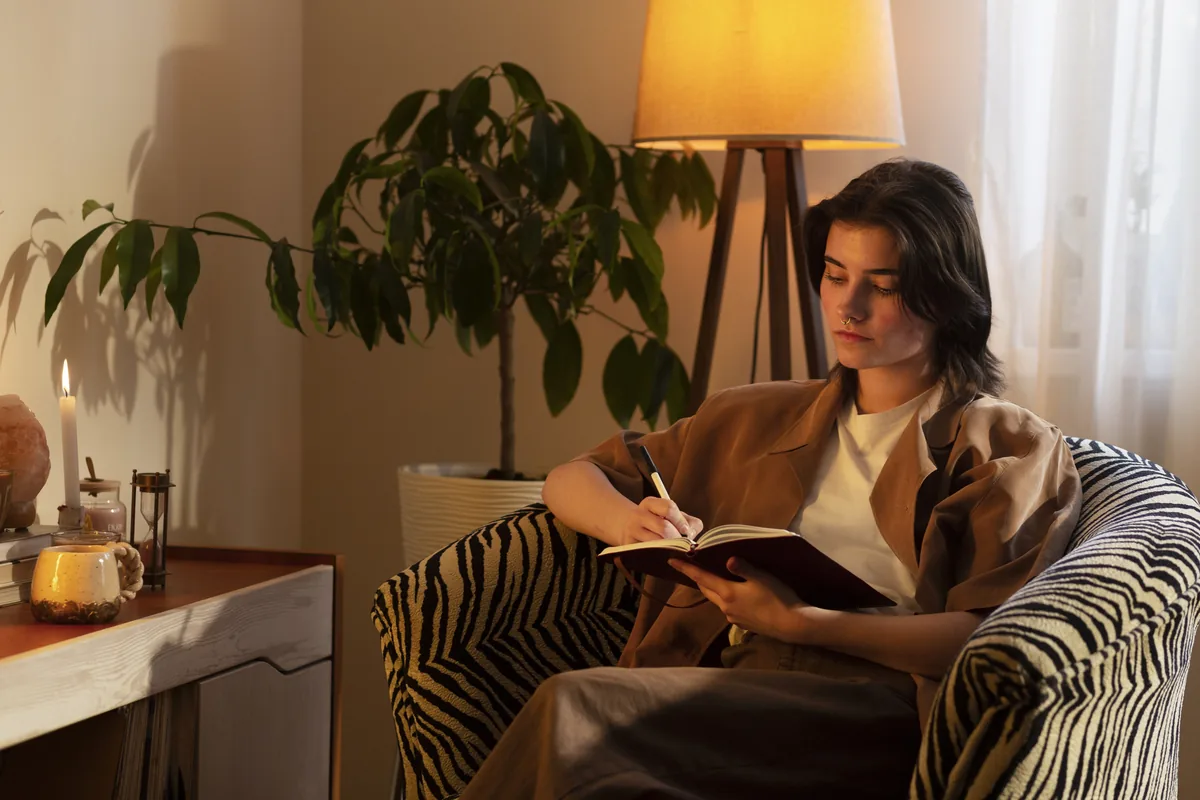
Be concrete: "email Dana about the invoice" beats "work stuff." The study tested writing at bedtime, so keep a notepad by the bed as well. If a task pops into your head later, add it to the list.
Close work for real. Check messages one last time, then switch on Do Not Disturb. If work keeps following you home, start with this two-minute shutdown ritual.
Mark the end of screen time. If your workday ends on a screen, give it a clear last stop. Our game, Munchy Ants, is a calm, no-timer color puzzle where ants eat a pixel-art picture made of sugar cubes, free to play on iPhone and Android. You tap a box and a line of ants marches out to munch the picture. The levels are short and the music is cozy. Play one short level as the line between work and evening, then put the phone on its charger outside the bedroom. It's not a bedtime game: it belongs at the start of your wind-down, not in bed with the lights off.

Munchy Ants
A calm color puzzle with no timer. Play at your own pace. Free to play.
1 hour before bed: dim lights, fewer screens
Light is a strong signal for your body clock, and in the evening most of it comes from ceiling lamps and screens held close to the face.
In a lab study at Brigham and Women's Hospital, Chang and colleagues had 12 healthy young adults read for about four hours before bed, in a dimly lit room, for five evenings on a light-emitting tablet at full brightness and five evenings with a printed book. After the tablet, they took about 10 minutes longer to fall asleep. Their evening melatonin, the hormone linked to sleepiness, dropped by about half, their body clock ran more than an hour and a half later, and they felt sleepier the next morning.
That was a tough test: four hours, full brightness and only 12 people. Most evenings involve less. Harvard Health also notes that links between light at night and health problems aren't proof of cause. Still, the advice points one way. Harvard Health suggests avoiding bright screens beginning two to three hours before bed, using dim red night lights and getting plenty of bright light during the day. The CDC says at least 30 minutes. One hour is a realistic middle.
What that looks like at home:
- Switch from ceiling lights to lamps. One or two warm lamps are enough to read by.
- Pick screens that end. One episode you chose, with autoplay off, beats an open-ended feed.
- Make the phone boring. Grayscale and a bedtime schedule help; here are the phone settings that make the feed less sticky.
30 minutes before bed: calm rituals
The last half hour is for low-stakes things that slow you down. Pick two or three and keep them the same each night:
- A warm shower, then pajamas.
- Gentle stretching for your neck, back and hips after a day at a desk.
- A paper book, read by lamplight until your eyes get heavy.
- Slow breathing: in for about four counts, out for about six, for a few minutes.
- A quiet chat with your partner or roommate about anything but logistics.
- A bedroom check: quiet, dark and cool, as the CDC suggests. Set a basic alarm clock so the phone can stay outside.
If you journal at night, the Scullin study offers a small hint: writing about the next few days, rather than replaying the day you just had, went with falling asleep faster.
A 10-step sample night routine
Here's one evening for someone who wakes at 6:30 a.m. and wants lights out around 10:30 p.m. Shift every time to fit your own day.
- 8:30 p.m. Clear the kitchen and pack tomorrow's lunch.
- 8:40 p.m. Lay out clothes and put your bag and keys by the door.
- 8:45 p.m. Write tomorrow's to-do list, as specific as you can.
- 8:50 p.m. Check messages one last time and switch on Do Not Disturb.
- 8:55 p.m. Put the phone on its charger outside the bedroom.
- 9:30 p.m. Turn off the ceiling lights and switch on a lamp or two.
- 9:30 to 10 p.m. Do something easy with a natural end: one episode, a chat with someone at home, folding laundry, a crossword on paper.
- 10 p.m. Warm shower, teeth, skincare if that's your thing.
- 10:10 p.m. Get the bedroom ready: cool, dark and quiet, with the alarm clock set.
- 10:15 p.m. Read a paper book in bed until you're sleepy, then lights out.
Keep roughly the same times on weekends, as the CDC advises. Give it a week before you judge it.
What should you avoid before bed?
A routine works better when a few habits stay out of the evening.
- Late caffeine. The CDC advises avoiding caffeine in the afternoon or evening. In a study at Henry Ford Hospital, Drake and colleagues gave 12 healthy sleepers a large dose of caffeine (400 mg) at bedtime, 3 hours before or 6 hours before. Even at 6 hours, it disturbed sleep on a home sleep monitor, while people's own sleep diaries didn't show the difference.
- Big meals and alcohol close to bedtime, both on the CDC's list of things to avoid.
- Work email in bed. Keep the laptop in another room.
- Long or late naps. If you nap, keep it short and early, before 3 p.m.
- Chasing a perfect routine. A missed night doesn't undo anything. Pick it up again tomorrow.
When is a night routine not enough?
A wind-down helps ordinary evenings. It isn't a treatment for a sleep problem. The CDC lists trouble falling asleep, waking up repeatedly during the night and feeling sleepy or tired even after enough sleep as signs of poor sleep quality, and it says to talk to your healthcare provider if you regularly have problems sleeping.
Do the same if racing thoughts or low mood keep you up for weeks. If you're struggling, call or text 988 (US) to reach the 988 Suicide & Crisis Lifeline.
Frequently asked questions
What is a good night routine for adults?
A good night routine for adults is a short, repeatable sequence that starts about two hours before bed. Close the day with chores and a to-do list, dim the lights an hour before bed, put the phone away and finish with something calm, like a warm shower or a paper book. Keep the same bedtime every day.
How long before bed should I stop using screens?
Aim for about an hour before bed. The CDC suggests turning off electronic devices at least 30 minutes before bedtime, while Harvard Health suggests avoiding bright screens beginning two to three hours before bed. One hour is a realistic middle for most people. If you do use a screen, lower the brightness and choose something that ends.
What time should I start my night routine?
Start about two hours before you want to fall asleep. Count back from your alarm: the CDC recommends at least 7 hours of sleep for adults aged 18 to 60. If you wake at 6:30 a.m., aim to sleep by 11 p.m. and begin winding down around 9 p.m. Then keep that timing on weekends too.
What is the 10-3-2-1-0 rule for sleep?
The 10-3-2-1-0 rule is a popular rule of thumb, not an official guideline. It means no caffeine 10 hours before bed, no food or alcohol 3 hours before, no work 2 hours before, no screens 1 hour before and zero snooze presses. It loosely matches CDC advice on caffeine, meals, alcohol and devices.
Does blue light from phones really keep you awake?
Bright screens late in the evening can delay sleep a little, but the studies are small. In one lab study of 12 people, four hours of reading on a bright tablet made them take about 10 minutes longer to fall asleep than a paper book. So dim the screen, but don't treat it as the only culprit.
Sources
- Chang, A. M., Aeschbach, D., Duffy, J. F., & Czeisler, C. A. (2015). Evening use of light-emitting eReaders negatively affects sleep, circadian timing, and next-morning alertness. Proceedings of the National Academy of Sciences, 112(4), 1232-1237.
- Scullin, M. K., Krueger, M. L., Ballard, H. K., Pruett, N., & Bliwise, D. L. (2018). The effects of bedtime writing on difficulty falling asleep: A polysomnographic study comparing to-do lists and completed activity lists. Journal of Experimental Psychology: General, 147(1), 139-146.
- Drake, C., Roehrs, T., Shambroom, J., & Roth, T. (2013). Caffeine effects on sleep taken 0, 3, or 6 hours before going to bed. Journal of Clinical Sleep Medicine, 9(11), 1195-1200.
- Harvard Health Publishing. Blue light has a dark side.
- Centers for Disease Control and Prevention. About sleep.
- 988 Suicide & Crisis Lifeline.
- Photos: cover by Freepik, evening journal by Freepik.
Munchy Ants
A calm color puzzle with no timer. Play at your own pace. Free to play.
This article is general information, not medical advice. If stress feels overwhelming, talk to a health professional. Written by the Munchy Ants team. See our editorial policy: how we research, check and correct our articles.