Hygge Lifestyle: 15 Cozy Danish Habits for Winter
What the hygge lifestyle really is and how to live it: 15 cozy Danish habits for winter evenings, food and time together. No shopping needed.

The hygge lifestyle is the Danish habit of making ordinary time feel warm, safe and unhurried: soft light, simple food, good company and no agenda. It isn't a look you buy. It's a way of spending a dark winter evening, alone or with people you like. Below you'll find what hygge really means, what research says about why it matters, and 15 cozy habits you can start tonight.
Key takeaways
- Hygge, said roughly "HOO-gah", is a Danish word for warm, cozy, unhurried time, usually shared with people you like.
- It isn't a shopping trend. Light, food, company and a slower pace matter more than new blankets or candles.
- Denmark ranked 3rd in the World Happiness Report 2026, but the report credits income, social support, health and freedom, not hygge.
- Strong social ties and enjoyable leisure are both linked to better health, which is reason enough to protect cozy evenings.
- Start small: one lamp-lit evening a week, one slow meal, one or two people invited.
What does hygge mean (and what isn't it)?
Hygge is a Danish word for a feeling of cozy, unhurried togetherness. VisitDenmark, the country's national tourism organization, says it roughly translates to "cosiness" and describes it as creating a warm atmosphere and enjoying the good things in life with good people. The Cambridge Dictionary defines it as a quality of cosiness (feeling warm, comfortable and safe) that comes from simple things like lighting candles, baking or spending time at home with family.
The roots are Scandinavian, and the story varies a little by source. VisitDenmark says the word came from old Norwegian, where it meant something like "well-being". The official website of Denmark, run by the Ministry of Foreign Affairs, says hygge in today's sense dates back to around 1800 and traces older meanings to an Old Norse word for being protected from the outside world.
English has no single word for it, which is why we borrowed this one. Psychologist Tim Lomas gathered 216 "untranslatable" words about well-being for a 2016 paper in the Journal of Positive Psychology. Writing about the project, he groups the Danish hyggelig and the Norwegian koselig among Scandinavian adjectives that roughly translate as "cosy". His point: a borrowed word can name a feeling we had overlooked.
Now, what hygge isn't. It isn't a shopping list, even though the word now sells plenty of throws, candles and mugs. Anthropologist Jeppe Trolle Linnet called his study of it "Money Can't Buy Me Hygge". He describes hygge as a style of social interaction: the pleasure of being tucked into a shared space, away from the pressures of modern life. He also notes a shadow side. Hygge can become a form of social pressure, with judgment toward people seen as unable to create it. So keep it relaxed. Hygge is not a test you can fail.
Why do Danes value hygge? What research says
Denmark often sits near the top of happiness rankings. In the World Happiness Report 2026, based on Gallup World Poll answers from 2023 to 2025, Denmark ranked 3rd. Finland was 1st, with Iceland, Denmark and Costa Rica in a close group behind it. The United States ranked 23rd.
It's tempting to hand hygge the credit. The report doesn't. It explains the rankings with six factors, including income, social support, healthy life expectancy and the freedom to make life choices. Denmark's official site asks whether hygge deserves some of the credit and leaves the question open. That's the honest answer: nobody has shown that cozy evenings make a whole country happy.
What research does support is the value of hygge's main ingredients, time with people and enjoyable leisure:
- Relationships. A review of 148 studies with 308,849 people found that people with stronger social relationships had a 50% greater likelihood of survival. The authors called the effect comparable to well-established risk factors for mortality.
- Leisure. Across four studies with 1,399 adults, people who did more enjoyable leisure activities had lower blood pressure and cortisol, more positive moods and less depression. It's a link, not proof, but a good nudge to guard your slow evenings.
If your weeks feel too full for any of this, start with our guide on how to slow down.
15 hygge lifestyle habits for winter
None of these need a budget. Pick two or three and repeat them until they feel like yours.
1. Turn off the big light
After dark, switch off the ceiling light and use two or three low lamps with warm bulbs. Pools of soft light make a room feel smaller and safer. Candles are the classic hygge image, but a lamp is the calmer choice with kids, pets or a habit of dozing off on the sofa.
2. Make one corner for doing nothing
A chair by the window, a blanket, a spot for a mug and a book within reach. Hygge needs a place to land. When you sit there, you're off duty.
3. Cook something slow
Soup, stew or a pot of chili on a gray Sunday. Slow food fills the house with good smells and gives the afternoon a shape. Make extra for a tired weeknight.
4. Bake without a goal
Cinnamon buns, a plain loaf, oat cookies. The point isn't a perfect bake. It's flour on the counter and a warm oven on a cold day.
5. Keep a warm drink ritual
Tea at four, cocoa after a walk, coffee in the same mug every morning. Holding something warm with both hands is about as hygge as it gets.
6. Dress for comfort, not for company
Wool socks, an old sweater, soft pants you'd never wear outside. Comfort is part of the mood, and it tells your body the day is over.
7. Go outside before dark
Hygge isn't only indoors. VisitDenmark's own examples include picnics and bike rides. In winter, a short walk in the last daylight makes coming home to a warm room feel even better.
8. Invite a few people, not many
Hygge works best in small groups: three or four friends around a table, not a party. If crowds drain you, check your social battery and keep the list short.
9. Share the cooking
Ask everyone to bring one dish, so nobody plays the host who never sits down. Denmark's official site says hygge often involves sharing a meal, with no agenda.
10. Leave phones in another room
One hour without notifications. Conversation needs room, and so does a little boredom.
11. Play something slow
A deck of cards, a board game, a jigsaw left out on the table for days so anyone can add a piece. Low-stakes play keeps hands busy and talk easy.
12. Read aloud or listen together
A chapter of a novel, a podcast episode, one whole album with the lights low. One shared story beats two people on two screens.
13. Make something with your hands
Knitting, mending, sketching, wrapping gifts. Repetitive handwork gives the evening a gentle rhythm.
14. Bring hygge to dark mornings
Turn on a lamp at breakfast, make porridge and take ten quiet minutes before the day starts. Winter mornings deserve warmth too.
15. Mark small seasonal moments
The first snow, the solstice, the first Sunday of Advent, a frosty walk. Give each a small ritual: a special breakfast, dinner by lamplight, a walk you repeat every year. For more December ideas, see our cozy Christmas activities for adults.
How can you hygge without buying anything?
Hygge comes from atmosphere and company, and both are cheap. Before you shop, try this with what you already have:
- Light: move a lamp, use the fairy lights from the holiday box, switch off the ceiling light.
- Texture: pile the blankets and sweaters you already own on the sofa.
- Food: cook from the pantry. Soup, pancakes and porridge cost little.
- Time: put one evening a week on the calendar and protect it like an appointment.
- People: send one text: "Soup at mine on Thursday?"
Many of our relaxing things to do at home take five minutes and nothing from a store. If the room itself needs some warmth, our guide to making your home cozy on a small budget covers light, texture and clutter.
Hygge with others and alone
Hygge is often shared, but Denmark's official site says you can have it by yourself too. Both versions run on the same idea: no rush, no performance, no agenda.
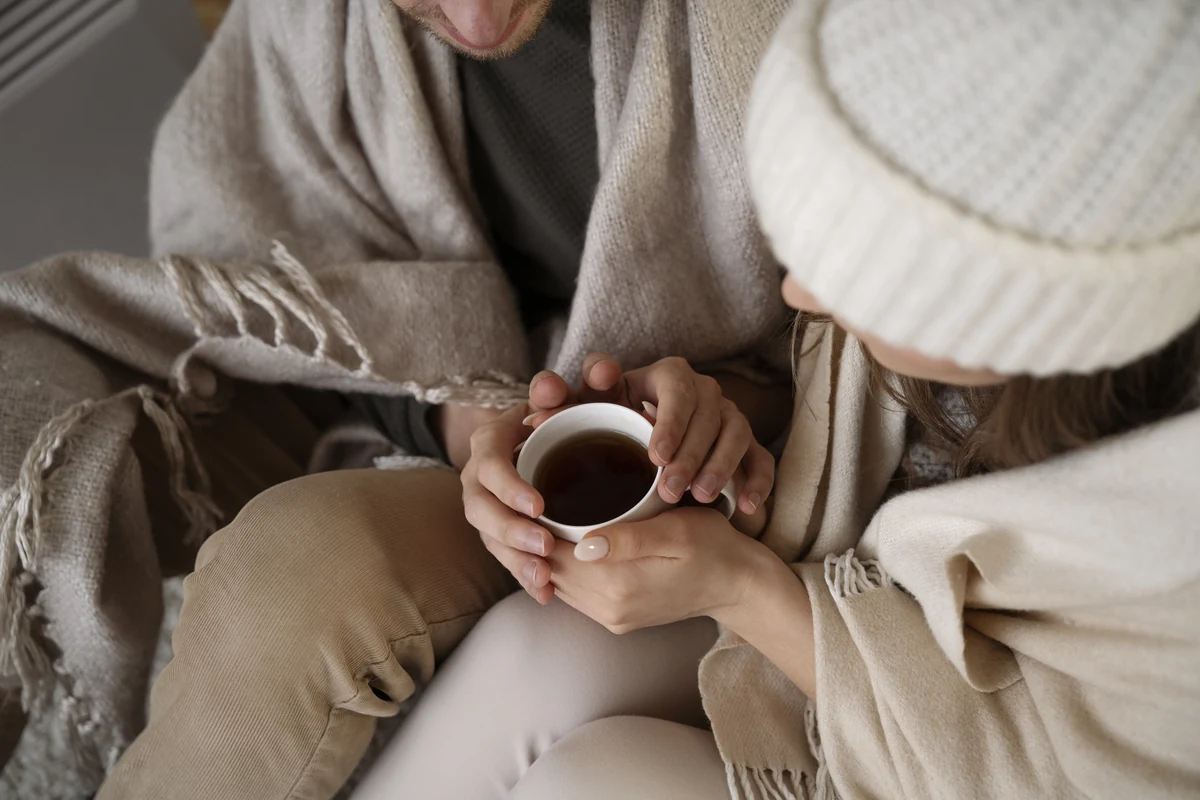
With others, keep it small and low-stakes. Cook one pot together, play cards or leave a jigsaw on the table that people work on all evening. The best hygge evenings feel easy to say yes to and easy to leave.
Alone, make the coziest version of a night in: a blanket, a warm drink, a book, and maybe one calm puzzle on your phone before screens go off. One option is our game, Munchy Ants: a calm, no-timer color puzzle where you tap a box and a line of ants marches out to eat a pixel-art picture made of sugar cubes. It's free to play on iPhone and Android.

Munchy Ants
A calm color puzzle with no timer. Play at your own pace. Free to play.
Alone time feels cozy when you choose it. If the quiet starts to feel heavy, text a friend and plan a shared evening.
A simple hygge evening plan
Here's one winter evening. Change anything you like.
- Late afternoon: take a short walk while there's still some light.
- Back home: lamps on, ceiling light off, comfortable clothes on.
- Dinner: one slow pot, shared with whoever is home, phones in another room.
- After dinner: cards, a jigsaw or a chapter read aloud.
- Last hour: a warm drink and a book or one calm puzzle, then screens off and bed.
No new purchases, no perfect photos. Repeat it weekly and it becomes a ritual.
Frequently asked questions
What does hygge mean in English?
Hygge has no exact English equivalent. The closest word is "coziness", but hygge also means warmth, safety and unhurried time with people you like, or on your own. The Cambridge Dictionary describes it as cosiness that comes from simple things, such as lighting candles, baking or spending time at home with family.
How do you pronounce hygge?
Hygge is pronounced roughly "HOO-gah". VisitDenmark, Denmark's national tourism organization, gives that spelling, and the Cambridge Dictionary lists /ˈhʊɡ.ə/ for both British and American English. The first vowel sounds like the "oo" in "hook", and the second syllable is short and soft. A close attempt is perfectly fine in conversation.
How do you live a hygge lifestyle?
You live a hygge lifestyle through small, repeated habits: lamps instead of overhead lights, slow food, a warm drink, comfortable clothes, phones put away and regular time with a few people you like. Start with one hygge evening a week. It needs no shopping, because atmosphere and company matter more than décor.
Is hygge only for winter?
No, hygge works all year, even though it is closely tied to dark Danish winters and Christmas. VisitDenmark's examples include picnics, barbecues with friends, outdoor concerts and bike rides. The idea stays the same in every season: a relaxed atmosphere, simple pleasures and good company, with no agenda and no rush.
Is hygge the reason Danes are so happy?
No one has proven that. Denmark ranked 3rd in the World Happiness Report 2026, but the report explains the rankings with factors such as income, social support, healthy life expectancy and freedom. Hygge may reflect strong social ties rather than cause happiness. Treat it as a pleasant habit, not a formula.
Sources
- Lomas, T. (2016). Towards a positive cross-cultural lexicography: enriching our emotional landscape through 216 'untranslatable' words pertaining to well-being. The Journal of Positive Psychology, 11(5), 546-558.
- Lomas, T. (2016, July 12). The magic of untranslatable words. Scientific American.
- Helliwell, J. F., Layard, R., Sachs, J. D., De Neve, J.-E., Aknin, L. B., & Wang, S. (Eds.). (2026). World Happiness Report 2026. University of Oxford: Wellbeing Research Centre.
- Linnet, J. T. (2011). Money can't buy me hygge: Danish middle-class consumption, egalitarianism, and the sanctity of inner space. Social Analysis, 55(2).
- Holt-Lunstad, J., Smith, T. B., & Layton, J. B. (2010). Social relationships and mortality risk: a meta-analytic review. PLoS Medicine, 7(7), e1000316.
- Pressman, S. D., et al. (2009). Association of enjoyable leisure activities with psychological and physical well-being. Psychosomatic Medicine, 71(7), 725-732.
- VisitDenmark. What is hygge? Denmark's national tourism organisation.
- Ministry of Foreign Affairs of Denmark. Hygge. denmark.dk.
- Cambridge Dictionary. Hygge. Cambridge University Press.
- Photos: cover by Freepik, tea under blankets by Freepik.
Munchy Ants
A calm color puzzle with no timer. Play at your own pace. Free to play.
This article is general information, not medical advice. If stress feels overwhelming, talk to a health professional. Written by the Munchy Ants team. See our editorial policy: how we research, check and correct our articles.